
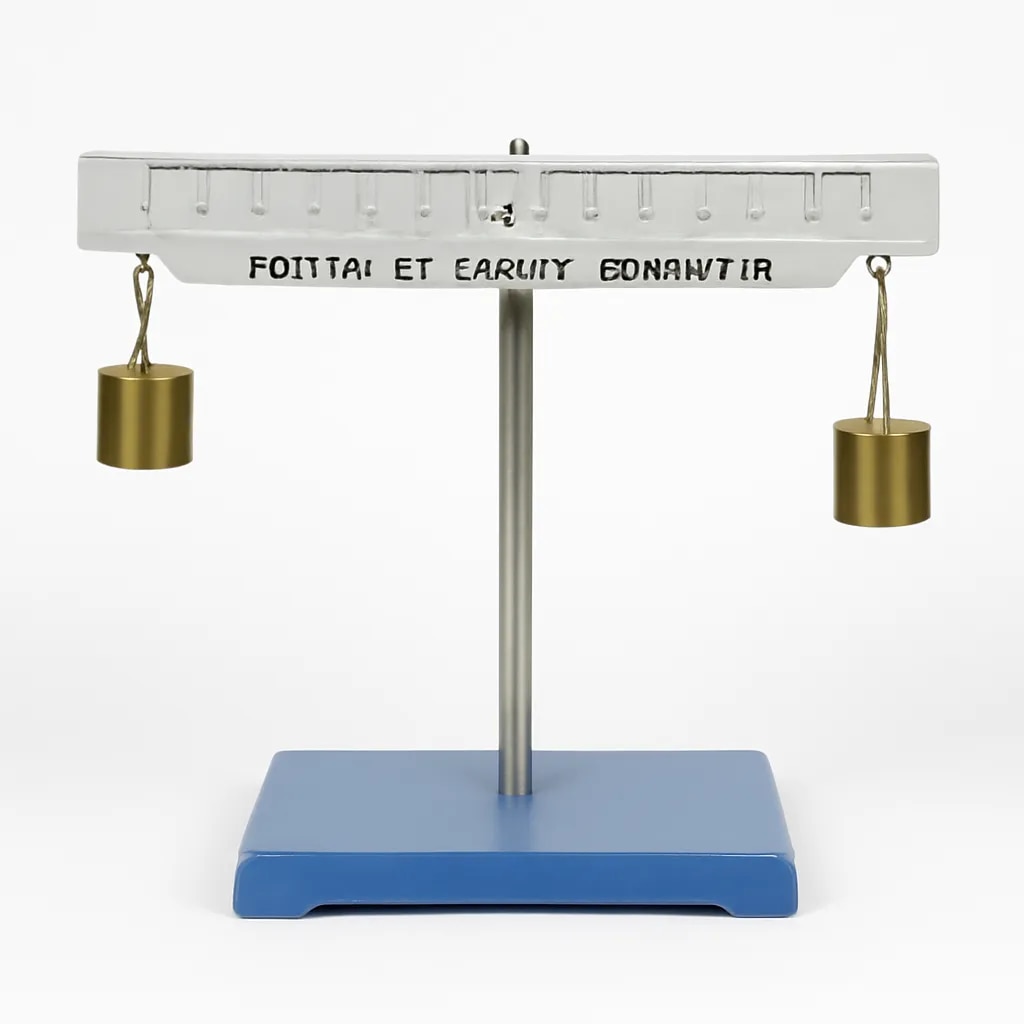
Centre of Gravity Apparatus
Description
Here’s a detailed description of the image showing a **Centre of Gravity Apparatus**:
---
### ⚖️ Centre of Gravity Apparatus – Visual Breakdown
#### 🧱 Structure & Materials
- **Base Platform**: A flat rectangular base made of sturdy metal or wood, typically painted black or gray, providing stability
- **Vertical Support Rod**: A tall metal rod mounted at the center or rear of the base, used to suspend components
- **Pivot Arm**: A horizontal metal bar attached to the vertical rod via a pivot or clamp, allowing rotation and balance testing
- **Suspended Shapes**: Various geometric shapes (e.g., triangle, rectangle, irregular polygon) made of lightweight metal or plastic, each with a small hole for hanging
- **Plumb Line**: A thin string with a small weight at the bottom, used to trace vertical alignment from the suspension point
---
### 🔍 Key Features
- **Adjustable Suspension Points**: Shapes can be hung from different corners or edges to observe how the plumb line intersects the center of gravity
- **Graduated Scale**: Some versions include a ruler or protractor on the base or arm to measure angles and distances
- **Marking Pins or Chalk**: Used to trace the plumb line’s path on the shape to determine the intersection point
---
### 🎓 Educational Purpose
- Demonstrates how the center of gravity shifts based on suspension point
- Helps students visualize balance, torque, and equilibrium
- Commonly used in physics and engineering labs
---
Let me know if you’d like a labeled diagram or a step-by-step guide on how to use the apparatus for experiments!