
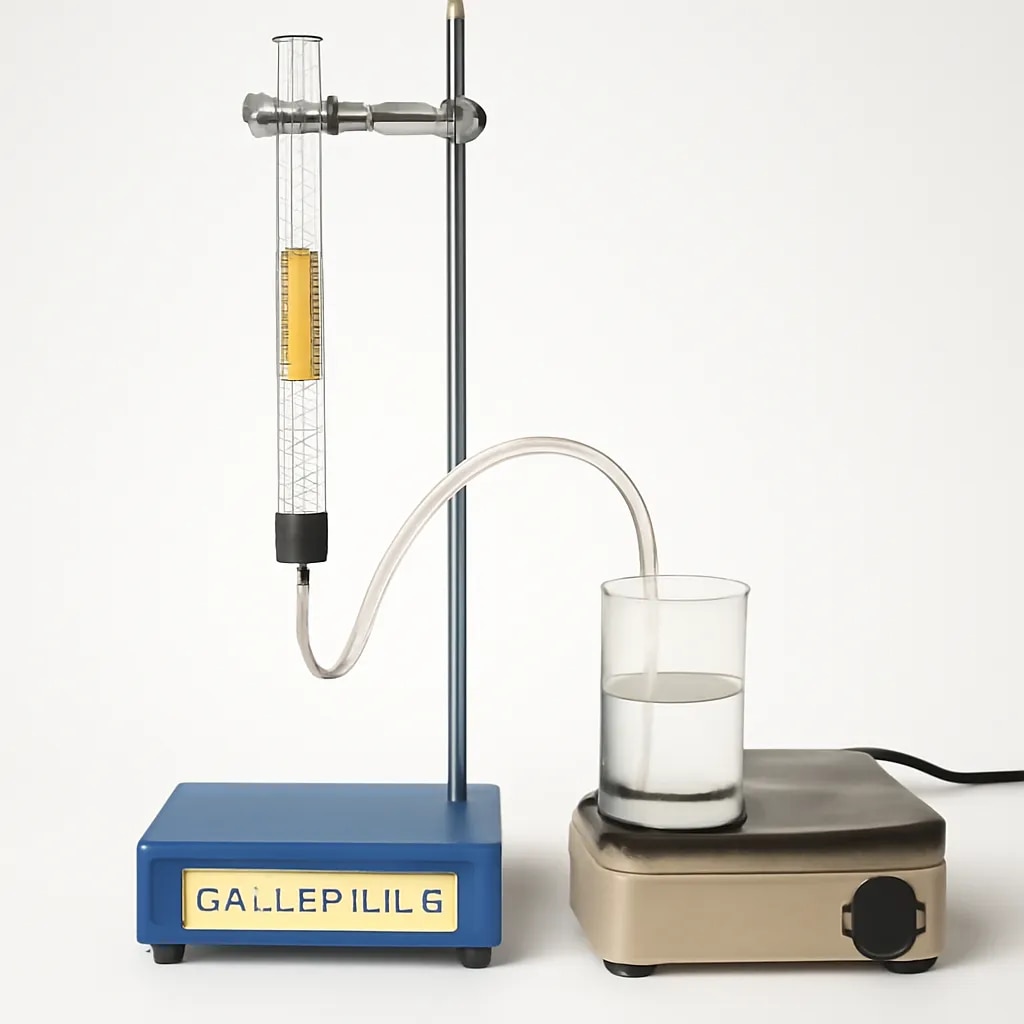
Charle's Law Apparatus, Complete
Description
Here’s a detailed description of a **Charle's Law Apparatus (Complete)**, commonly used in physics and chemistry labs to demonstrate the relationship between temperature and volume of a gas:
---
### 🌡️ Charle's Law Apparatus – Complete Setup
#### 🧱 Components & Materials
- **Glass Tube**: A long, sealed capillary or graduated glass tube partially filled with air and a colored liquid (usually mercury or colored water) to mark the air column
- **Water Bath**: A transparent container (often made of acrylic or glass) filled with water, used to control temperature
- **Thermometer**: Inserted into the water bath to monitor temperature changes accurately
- **Scale or Ruler**: Attached alongside the glass tube to measure the volume (length) of the trapped air column
- **Mounting Stand**: A metal or plastic frame that holds the glass tube vertically and secures the water bath
- **Heating Source**: Typically a Bunsen burner or electric heater placed beneath the water bath to gradually increase temperature
- **Stirrer**: Sometimes included to ensure uniform temperature distribution in the water bath
---
### 🔍 How It Works
- The trapped air in the sealed tube expands as the temperature of the water bath increases.
- The colored liquid acts as a marker, showing the change in volume.
- Measurements of air column length are taken at various temperatures to observe the direct relationship:
**Volume ∝ Temperature (at constant pressure)**
---
### 🎓 Educational Purpose
- Demonstrates **Charle’s Law**, which states that the volume of a gas increases linearly with temperature when pressure is constant.
- Helps students understand thermal expansion and gas behavior.
- Often used in conjunction with data logging for graphing volume vs. temperature.
---
Let me know if you’d like a diagram or a step-by-step experiment guide to go with this!