
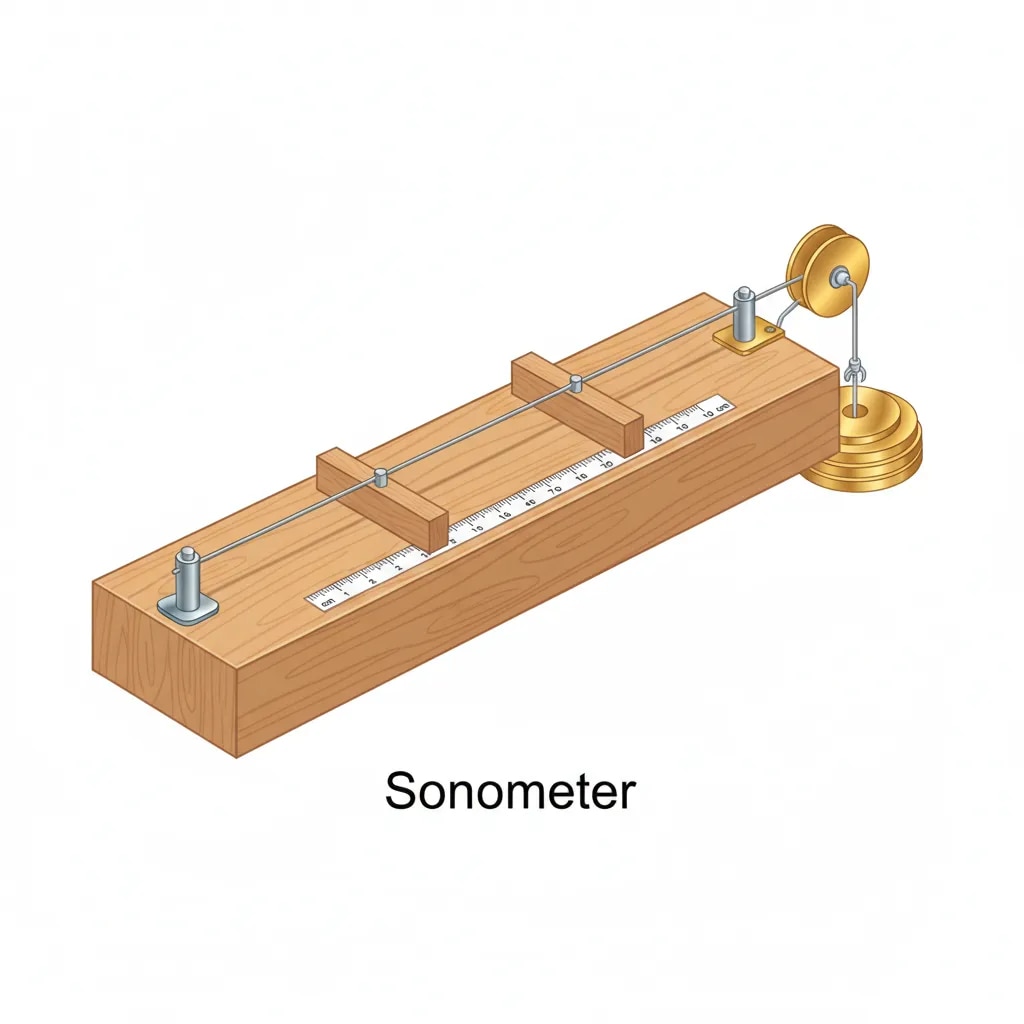
Sonometer
Description
A sonometer is a scientific instrument used primarily in physics laboratories to demonstrate the relationship between the frequency of sound produced by a vibrating string and the string's tension, length, and mass per unit length.
Construction
It typically consists of a long wooden box with a stretched metallic wire fixed at both ends.
One end of the wire is connected to a hook, while the other end is attached to a weight hanger via a pulley.
The tension in the string can be altered by adding weights to the weight hanger.
Two adjustable bridges or knives on the box allow for changing the vibrating length of the wire.
Working
When the wire is plucked, it vibrates producing a sound of a certain frequency.
The frequency depends on the tension, length, and mass per unit length of the string.
A transverse standing wave is produced on the wire, featuring nodes and antinodes.
By changing tension or length, the frequency of vibration changes, which can be studied using the sonometer.
Purpose and Applications
It illustrates fundamental principles of wave mechanics and resonance.
Used to verify laws of transverse vibrations such as the effect of length, tension, and material on the string's frequency.
Helps in understanding the physics behind musical instruments and sound waves.
Educational tool for students and researchers to examine relationships in vibrating systems.