
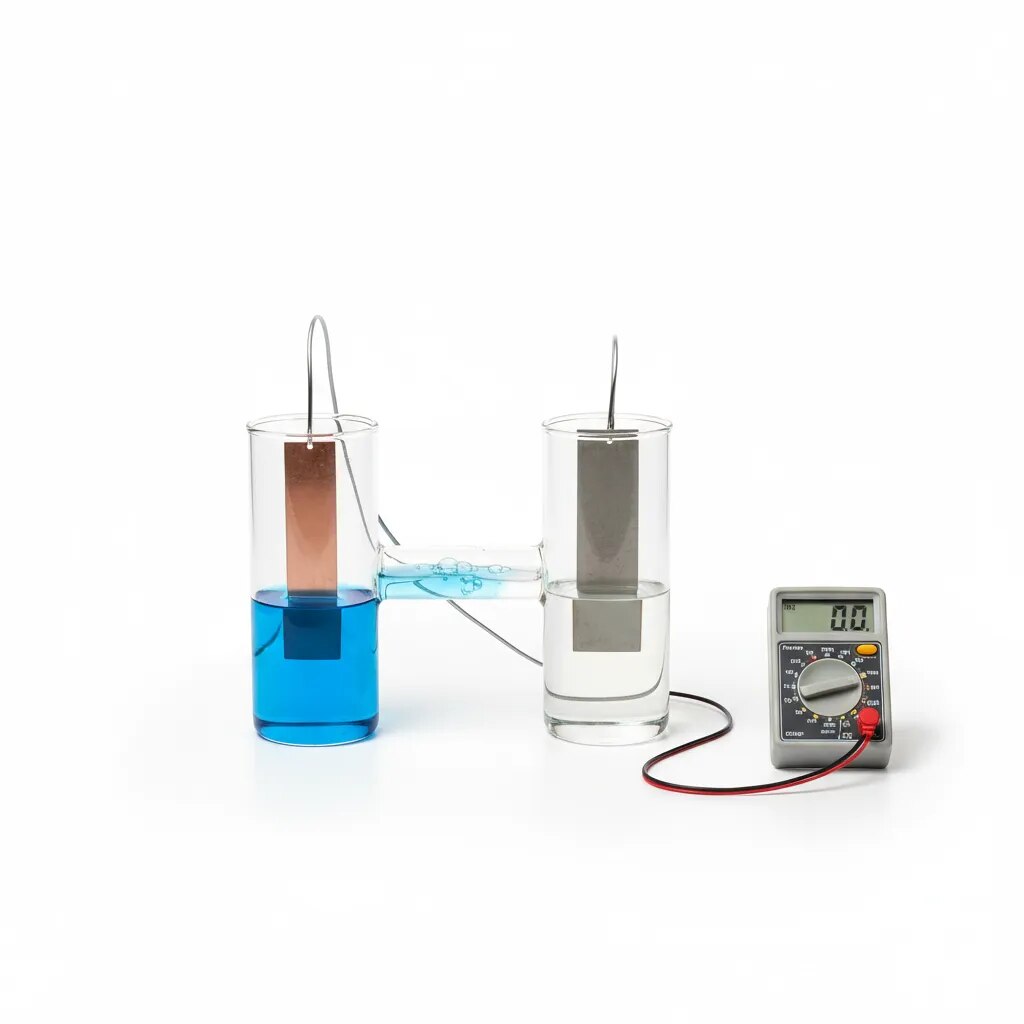
Voltaic Cell- Standard Size, Complete
Description
A Voltaic Cell, also known as a Galvanic Cell, is an electrochemical device that converts chemical energy into electrical energy through spontaneous redox (oxidation-reduction) reactions. It comprises two half-cells, each containing a metal electrode immersed in an electrolyte solution. These half-cells are connected by a salt bridge or porous barrier that allows ions to flow and maintain charge balance.
Key components of a standard size complete voltaic cell include:
Two metal electrodes: commonly copper (Cu) as the cathode and zinc (Zn) as the anode.
Electrolyte solutions: generally 1 M solutions of Cu^2+ and Zn^2+ ions in separate compartments.
Salt bridge: a tube filled with a neutral electrolyte that connects the two half-cells to complete the circuit.
External wiring connecting the electrodes to allow electron flow.
Working principle:
Oxidation occurs at the anode (zinc electrode), releasing electrons and Zn^2+ ions into the solution.
Reduction occurs at the cathode (copper electrode), where Cu^2+ ions gain electrons to form copper metal.
Electrons flow through the external circuit from anode to cathode, generating electric current.
Ion flow through the salt bridge maintains electrical neutrality in the solutions.
The standard cell potential for a Zn-Cu voltaic cell is about 1.1 volts under standard conditions (1 M ion concentration, 25°C). Voltaic cells are fundamental to understanding batteries and electrochemical energy conversion. The generated image represents a classic voltaic cell setup with clear labeling of electrodes, electrolyte, and connection components