
Amoeba
Description
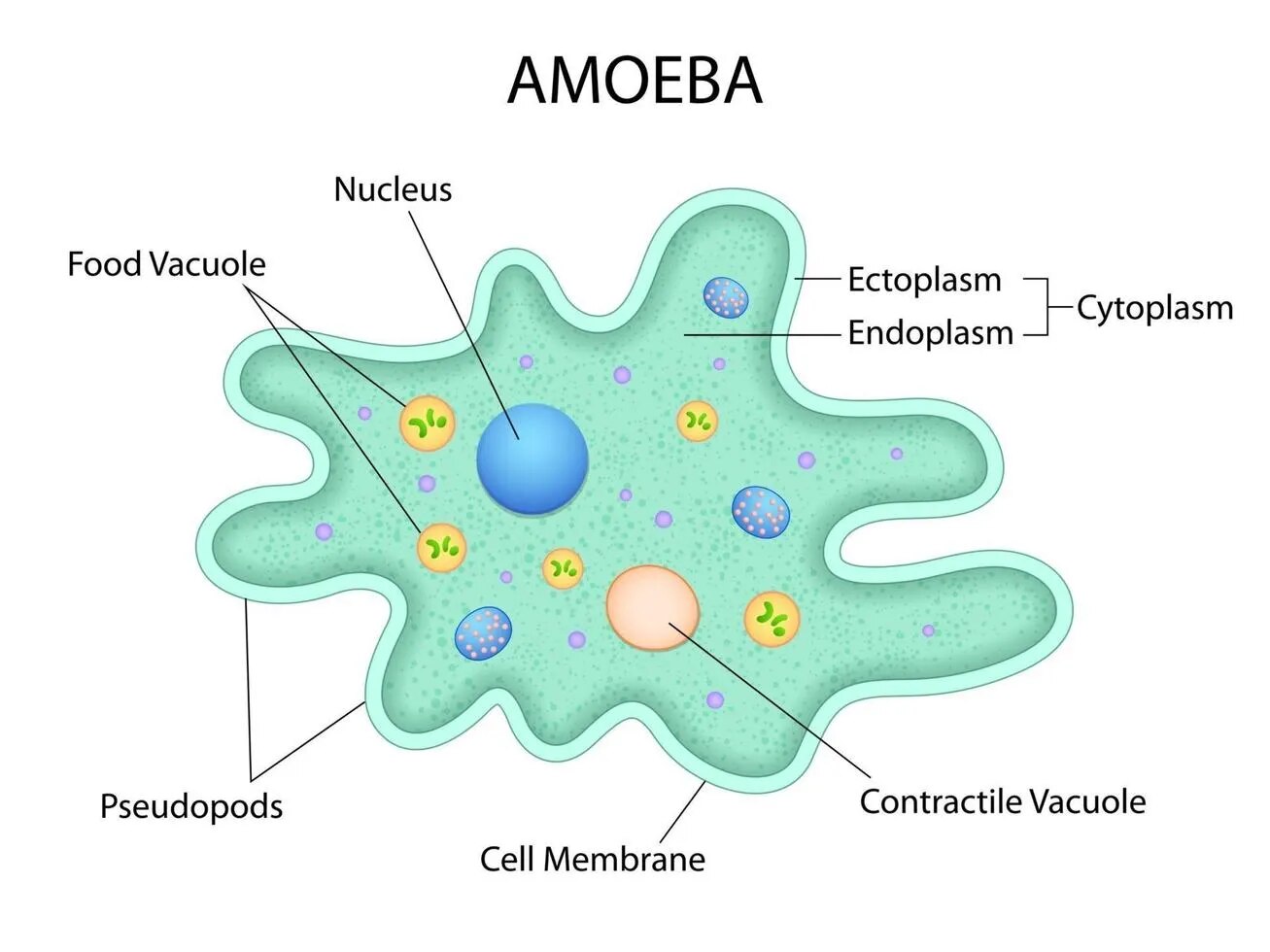
An amoeba is a unicellular, shapeless, and colorless microorganism composed of a jelly-like structure capable of continually changing shape due to its flexible cell membrane and cytoplasm.
Structure and Organelles
The main parts are the plasma membrane, cytoplasm (differentiated into outer ectoplasm and inner endoplasm), and a centrally located nucleus that controls all functions and contains genetic material.
Amoeba possess pseudopodia (“false feet”), which are finger-like cytoplasmic extensions used for movement and engulfing food particles by phagocytosis.
Other organelles include food vacuoles (where ingested food is stored and digested), contractile vacuoles (regulate water balance/osmoregulation), mitochondria, Golgi apparatus, and fat globules.
Function and Adaptation
Amoeba moves by extending and retracting its pseudopodia, allowing rapid changes in shape and locomotion—this is termed “amoeboid movement”.
It feeds using phagocytosis (engulfing solid food) and pinocytosis (absorbing liquids), digesting particles inside food vacuoles.
Reproduction is asexual, typically by binary fission, producing identical daughter cells; under harsh conditions, amoeba form protective cysts and 'reawaken' when conditions improve.
Although its lifespan is just a few days, binary fission essentially makes the lineage immortal.
Specifications
| Model No. | N-EM065 |
|---|


