
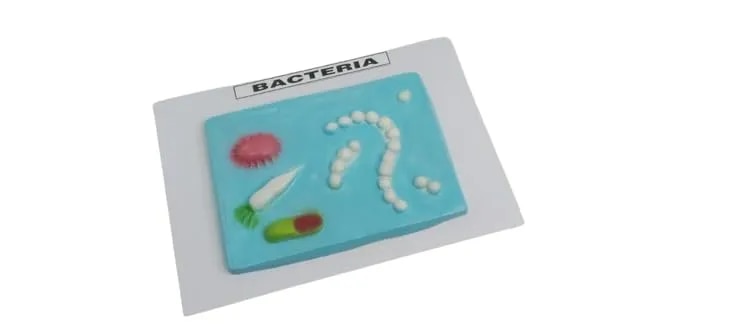
Bacteria, Small Size
Description
Bacteria are microscopic, single-celled organisms that typically range from 0.2 to 2 micrometers (μm) in diameter and up to 5 μm in length, making them about one-tenth the size of most eukaryotic cells.
Reasons for Small Size
Nutrient Exchange: Their small size provides a high surface area-to-volume ratio, allowing efficient exchange of nutrients and waste materials with the environment. This is essential for rapid growth and survival, especially in nutrient-poor conditions.
Adaptive Advantage: Small size enables bacteria to thrive in diverse and sometimes extreme habitats, and allows them to quickly respond to environmental changes through faster cell division.
Minimum Cellular Components: Even the smallest bacteria must be large enough to accommodate essential biomolecules such as DNA, proteins, and ribosomes. However, the lower limit is typically about 0.15 μm in diameter; cells smaller than this may not function independently.
Range of Sizes
Common Sizes: Most bacteria, like Escherichia coli, are about 1–2 μm long and 0.5 μm wide.
Smallest Bacteria: Some of the smallest, such as Mycoplasma species, can be as tiny as 0.1–0.3 μm in diameter, approaching the size of larger viruses.
Ultrasmall Bacteria: “Ultrasmall” bacteria, found in certain environments, can average as little as 0.2 μm in diameter and sometimes down to ∼150 nanometers.
Specifications
| Model No. | N-EM0103 |
|---|


