
Binary Fisson
Description
Answer
Images
study.com favicon
byjus.com favicon
britannica.com favicon
Sources
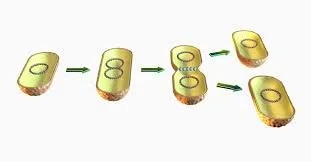
Binary fission is a simple and efficient form of asexual reproduction found in bacteria, archaea, and some single-celled eukaryotes like amoeba and paramecium. In this process, a single parent cell divides into two genetically identical daughter cells.
Steps of Binary Fission
DNA Replication: The cell’s genetic material (usually a single, circular DNA molecule in prokaryotes) unwinds and is copied, producing two identical DNA molecules.
Cell Growth & Elongation: The cell increases in size, and the two DNA molecules are pulled toward opposite ends (poles) of the cell.
Septum Formation: The cell membrane and wall begin to pinch inward at the center, forming a division (septum) between the two sets of DNA.
Separation: The septum fully develops, splitting the parent cell into two daughter cells—each with a full copy of genetic material and sufficient cytoplasmic contents for independent life.
Types and Examples
Binary fission can occur as irregular (any plane, e.g., amoeba), longitudinal, transverse, or oblique, depending on the organism and axis of division.
Examples:
Prokaryotes: Escherichia coli, Salmonella, Mycobacterium tuberculosis, cyanobacteria.
Eukaryotes: Amoeba, paramecium (with variations in nuclear division).
Specifications
| Model No. | N-EM0139 |
|---|


