
Budding In Hydra
Description
Budding in Hydra is a classic example of asexual reproduction, where a new individual develops as an outgrowth—or “bud”—on the body of the parent organism.
Process of Budding in Hydra
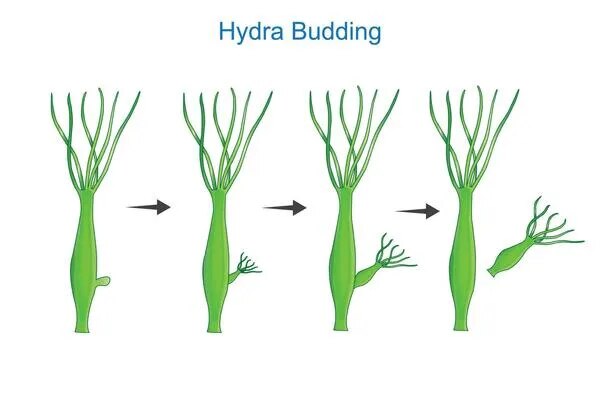
Initiation: Budding begins with repeated mitotic cell division at a specific region of the Hydra’s body, usually along the side or basal region. This produces a small outgrowth called a bud.
Development: The bud grows as more cells are added, forming layers of epidermis and gastrodermis and a cavity continuous with the parent’s gastrovascular cavity. The bud starts developing essential structures—tentacles and mouth.
Differentiation & Maturation: As the bud enlarges, its organs differentiate and develop, forming a complete miniature Hydra still attached to the parent.
Separation: Once the bud is sufficiently mature, a constriction forms at its base, and the new Hydra detaches from the parent, becoming independent.
Repetition: Hydra is capable of producing multiple buds simultaneously; this enables rapid population growth and colonization in favorable environments.
Educational Model Features
Zoology models of “Budding in Hydra” generally show the parent Hydra with developing buds, highlighting formation, growth, differentiation, and separation.
The model illustrates tentacles, mouth development, and the overall process by which genetically identical offspring are formed.
Budding in Hydra demonstrates remarkable regenerative power and is an efficient method for propagation, ensuring rapid reproduction and survival in stable aquatic habitats.
Specifications
| Model No. | N-EM092 |
|---|


