
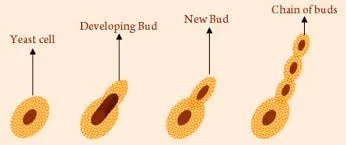
Budding In Yeast
Description
Budding in yeast is a form of asexual reproduction in which a new organism (daughter cell) develops as an outgrowth (bud) from the parent cell, eventually detaching to become an independent cell.
Steps of Budding
A small bud appears on the surface of the mature parent yeast cell when conditions are favorable.
The nucleus of the parent cell undergoes mitotic division, and one daughter nucleus migrates into the developing bud.
The bud grows in size as it receives nuclear material and cytoplasm from the parent cell.
Once the bud matures, it separates from the parent cell; sometimes, new buds form before the previous one has detached, resulting in chains of connected yeast cells.
Features and Significance
Budding is rapid and efficient, allowing yeast populations to multiply swiftly under ideal conditions such as abundant nutrients.
Genetically, the daughter cell is identical to the mother cell except for rare mutations, typical of asexual reproduction.
Some yeasts may form multiple buds successively, resulting in branching or unbranched chains.
This process is fundamental to yeast growth in brewing, baking, biotechnology, and laboratory experiments, ensuring quick colony expansion.
Specifications
| Model No. | N-EM0107 |
|---|


