
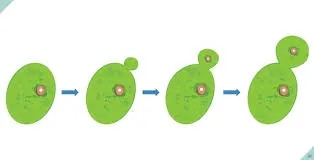
Budding In Yeast
Description
Budding in yeast is a type of asexual reproduction where a new daughter cell forms as a small outgrowth (bud) on the parent cell’s surface. This process allows yeast to rapidly multiply and form colonies, especially when nutrients are abundant.
Steps of Budding in Yeast
Bud Formation: The parent yeast cell develops a tiny protuberance or bulge, called a bud, on its surface.
Nuclear Division: The nucleus of the parent cell divides by mitosis. One daughter nucleus migrates into the developing bud, while the other remains in the parent cell.
Bud Growth: The bud enlarges by accumulating cytoplasm and organelles from the parent cell. The parent and bud remain attached while the bud matures.
Separation: When the bud has fully matured, it may either detach from the parent and become a new, independent yeast cell or remain attached, sometimes forming chains or clusters of budding cells.
Features and Importance
Budding is an unequal division: the daughter cell (bud) is initially smaller than the parent.
It enables rapid yeast colony formation, particularly important in baking, brewing, and biotechnology.
Some yeast cells can undergo several budding cycles before separating, leading to branched or unbranched chains of cells.
Specifications
| Model No. | N-EM0138 |
|---|


