
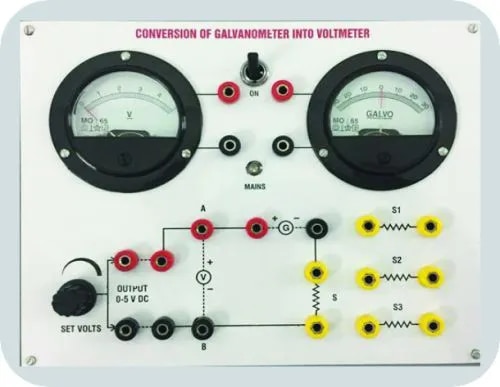
Conversion of Galvanometer into a Voltmeter & Ammeter
Description
A galvanometer is modified to act as a voltmeter by connecting a high resistance (multiplier) in series, increasing its voltage measuring range.
For ammeter conversion, a low resistance (shunt) is added in parallel, allowing the instrument to read higher currents safely.
Apparatus Design:
The core unit contains a moving-coil galvanometer with terminals for easy addition of external resistors.
Supplied with a set of precision multiplier resistances (for voltmeter conversion) and shunt resistances (for ammeter conversion).
Clearly marked and robust terminals or switches allow for quick reconfiguration between voltmeter and ammeter modes.
Operation:
To use as a voltmeter, the multiplier resistor is connected in series with the galvanometer—calibration is done for a specific voltage range.
For ammeter function, the shunt is placed in parallel—calibration is done for a specific maximum current range.
Scales and circuit arrangements are often provided to illustrate both connections in a laboratory setting.
This multifunctional apparatus is ideal for practical demonstrations of meter conversions in physics and electronics labs, directly supporting concepts of series and parallel resistance behavior in measurement applications.
Specifications
| Model No. | N-EL055 |
|---|


