
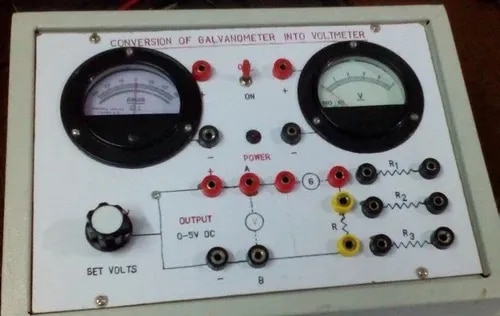
Conversion of Galvanometer into a Voltmeter
Description
Principle: A galvanometer measures small currents, but to measure voltage, it must be modified to withstand higher voltages without full-scale deflection. This is achieved by connecting a high resistance (known as a “multiplier resistor”) in series with the galvanometer.
Apparatus:
A sensitive galvanometer,
A precision series resistor (multiplier),
Connecting wires,
Terminals and a calibrated scale.
Operation: When voltage is applied across the combination, only a tiny fraction of current (proportional to the voltage) passes through the galvanometer, protecting the coil and ensuring readings within the instrument's range. The scale is then calibrated in volts instead of amperes or milliamperes.
Formula: The total resistance
R
R required in series is
R
=
V
I
g
−
G
R=
I
g
V
−G
where
V
V is the maximum voltage to be measured,
I
g
I
g
is the full-scale deflection current of the galvanometer, and
G
G is its internal resistance.
This conversion apparatus is invaluable for educational demonstrations, showing practical applications of Ohm’s Law and extending the utility of a galvanometer for voltage measurements.
Specifications
| Model No. | N-EL053 |
|---|


