
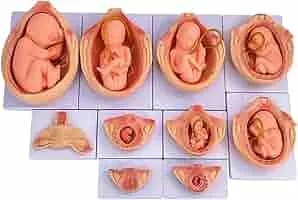
Development Of Embryo In 9 Parts
Description
The development of the human embryo in 9 parts represents a sequential timeline of embryogenesis from fertilization to early organ formation.
Description of the 9 Stages of Embryo Development
Fertilization and Zygote Formation: The sperm fertilizes the egg forming a single-celled zygote, which then undergoes rapid cell division while traveling down the fallopian tube.
Blastocyst Formation: By around days 5-6, the embryo forms a hollow structure called the blastocyst composed of an outer trophoblast and an inner cell mass, which will become the fetus.
Implantation: The blastocyst attaches and embeds itself into the thickened endometrium of the uterus, establishing maternal connection.
Gastrulation: Three germ layers form — ectoderm, mesoderm, and endoderm — which will give rise to all tissues and organs.
Neurulation: The neural tube forms, which will develop into the brain and spinal cord.
Somitogenesis: Somite pairs are formed, which later become segments of the vertebrae, muscles, and skin.
Organogenesis Begins: Early formation of major organs, including the heart that begins beating around day 22.
Limb Buds and Sensory Organ Development: Appearance of limb buds, eyes, ears, and other sensory structures starts.
Continued Growth and Differentiation: Refinement of organ systems, growth of limbs, digits, and overall morphology.
Specifications
| Model No. | N-EM051 |
|---|


