
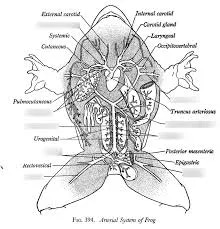
Frog Arterial System
Description
Structure and Major Arteries
The arterial system begins at the truncus arteriosus, which emerges from the ventricle and splits into right and left branches, each giving rise to three arches—carotid (front), systemic (middle), and pulmocutaneous (rear).
Carotid Arch: Supplies the head and brain. Each branch further divides into the external carotid (to jaw/tongue) and internal carotid (to brain/orbit), with the carotid body/labyrinth serving as an oxygen sensor.
Systemic Arch: The two arches curve around the esophagus, unite to form the dorsal aorta, which carries blood to the body’s organs and tissues. Offshoots include arteries to the esophagus, head, vertebral column, and spinal cord.
Pulmocutaneous Arch
Directs deoxygenated blood for oxygenation to the skin and lungs, dividing into the pulmonary artery (to lungs) and cutaneous arteries (to skin).
This unique adaptation lets frogs obtain oxygen both by breathing and through their skin.
Distribution
Dorsal aorta supplies blood to organs via several arteries, such as:
Celiac and mesenteric arteries (to liver, gut, pancreas)
Genital arteries (to gonads)
Renal arteries (to kidneys)
Iliac arteries (to legs and feet).
Each iliac artery gives femoral (hip/thigh) and sciatic (shank/foot) arteries for limb circulation.
Specifications
| Model No. | N-EM069 |
|---|


