
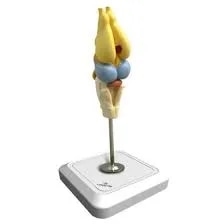
Frog Brain
Description
The frog brain is a compact, bilaterally symmetrical structure divided into three main regions: forebrain (prosencephalon), midbrain (mesencephalon), and hindbrain (rhombencephalon). The brain is protected by the cranium and transitions into the spinal cord at the medulla oblongata.
Structure and Main Parts
Forebrain: Consists of paired olfactory lobes (sense of smell), cerebral hemispheres (voluntary muscle control, simple learning, and memory), and the diencephalon (containing the pineal body and hypothalamic region).
Midbrain: Features two prominent optic lobes responsible for vision and processing visual stimuli.
Hindbrain: Includes the cerebellum (balance and muscle coordination) and medulla oblongata (regulation of involuntary activities such as respiration, heartbeat, and digestion).
Key Functional Aspects
The frog brain is relatively small with a proportionately larger optic lobe and cerebellum compared to the cerebrum.
Frogs possess 10 pairs of cranial nerves that carry sensory and motor information between the brain and the rest of the body.
The spinal cord continues from the medulla oblongata, relaying information to and from the brain.
The frog brain is specialized for sensory processing, muscular coordination, and basic autonomous regulation necessary for amphibian life.
Specifications
| Model No. | N-EM073 |
|---|


