
Frog Reproductive (Male)
Description
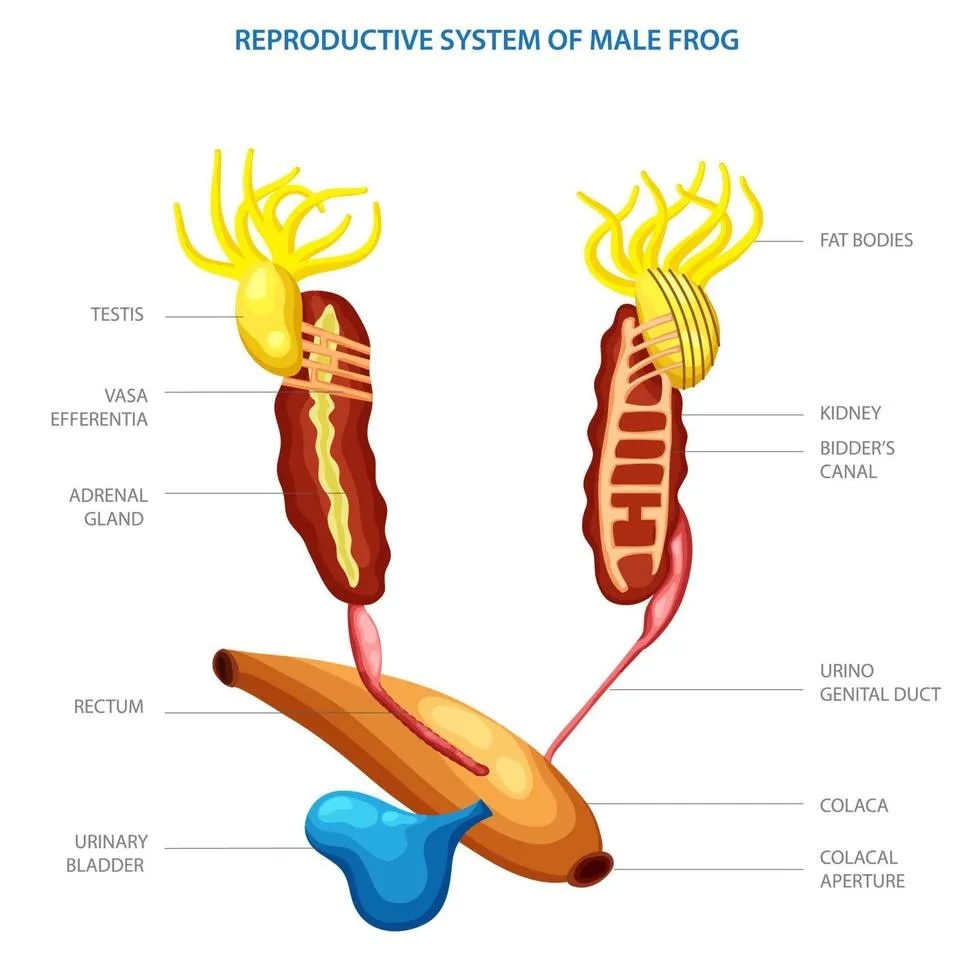
The male frog reproductive system is primarily composed of a pair of yellowish, ovoid testes attached to the kidneys and dorsal body wall by folds of peritoneum called mesorchium. The testes produce sperms, which travel through fine tubes called vasa efferentia, pass into the kidneys, and connect to Bidder’s canal before moving to the ureter, also called the urinogenital duct in males.
Structure and Function
Testes: Two oval, whitish or yellow structures situated ventral and anterior to the kidneys, suspended by mesorchium.
Vasa efferentia: About 10 to 12 small tubules carry sperm from the testes to the kidneys.
Bidder’s canal: A channel within the kidney where the vasa efferentia open, allowing sperm to mix with urine temporarily.
Urinogenital duct (ureter): Transports sperm from the kidneys to the cloaca, serving both excretory and reproductive functions.
Cloaca: The common chamber where urine, feces, and sperm exit the body.
Key Points for Educational Models
Males are distinguishable by external features such as vocal sacs and nuptial pads, used during breeding to grasp females during amplexus.
The reproductive and excretory systems are closely associated, sharing some ducts for sperm and urine.
Sperm are released externally via the cloaca during mating, fertilizing eggs as the female lays them in water.
The system efficiently supports external fertilization and reproductive functions, with unique adaptations for aquatic egg laying and sperm transfer.
Specifications
| Model No. | N-EM072 |
|---|


