
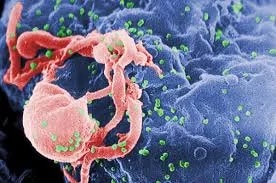
Hiv Virus
Description
The HIV virus (Human Immunodeficiency Virus) is a small, spherical retrovirus with a diameter of approximately 100–120 nm, responsible for causing AIDS by attacking the body's immune system, particularly the CD4+ T cells.
Structure
HIV consists of two copies of single-stranded positive-sense RNA tightly bound to nucleocapsid proteins and essential enzymes such as reverse transcriptase, integrase, and protease within a cone-shaped capsid (protein p24).
The capsid is surrounded by a matrix protein (p17), and the entire complex is enveloped in a lipid bilayer taken from the host cell membrane.
Embedded within this envelope are viral glycoproteins: gp120 (surface) and gp41 (transmembrane), which allow the virus to attach and fuse with target cells, initiating infection.
Genome and Proteins
The HIV genome contains about 9,800 nucleotides, encoding nine major genes that produce fifteen viral proteins—these include structural proteins (Gag, Pol, Env) and regulatory/accessory proteins (Tat, Rev, Nef, Vif, Vpr, Vpu).
Env glycoproteins (gp120/gp41) are major targets for immune response but are heavily shielded by a dense cluster of glycans, hindering neutralization by antibodies.
Life Cycle and Function
HIV infects CD4+ T cells through a seven-stage cycle including attachment, fusion, reverse transcription, integration, replication, assembly, and budding, using host cellular machinery to reproduce.
The virus integrates its genetic material into the host genome, leading to persistent infection and immune system decline over time.
Specifications
| Model No. | N-EM063 |
|---|


