
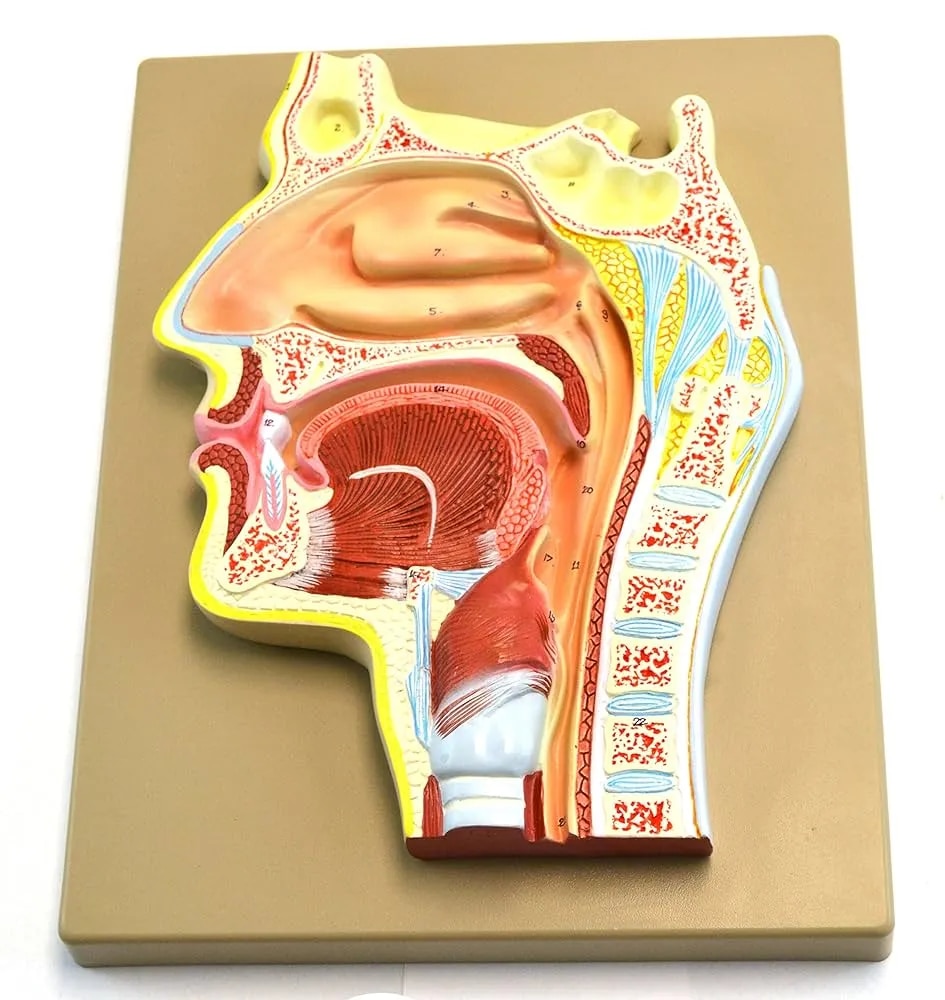
Human Nose
Description
The human nose is a prominent facial structure that serves as the main entrance to the respiratory tract and houses the organ of smell.
External and Internal Structure
Externally, the nose consists of a root (top), dorsum (bridge), apex (tip), nostrils (nares), and the columella, all supported by bone and cartilage.
The bony framework includes the nasal bones, maxillae, and frontal bone, while cartilage (major and minor alar, lateral, septal) gives the nose its shape and flexibility.
Internally, the nose contains the nasal cavity, which is divided by the nasal septum into two chambers.
Nasal Cavity Features
The nasal cavity has three main regions: the vestibule (entrance with hair follicles), respiratory region (lined with specialized epithelium for humidifying and filtering air), and olfactory region (contains smell receptors at the roof).
Three bony shelves called nasal conchae (inferior, middle, superior) project from the lateral walls, creating air channels that enhance warming, humidification, and filtration.
Paranasal sinuses—frontal, maxillary, ethmoid, and sphenoid—are air-filled extensions lined with mucosa, helping lighten the skull and contribute to voice resonance.
Functions
The nose warms, moistens, and filters inhaled air through mucous membranes and cilia, while specialized cells detect odors in the olfactory region.
During breathing, the nose prevents debris and pathogens from entering the lower airways by trapping them in mucus.
Specifications
| Model No. | N-EM055 |
|---|


