
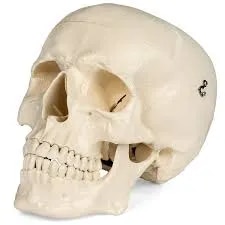
Human Skull
Description
Major Parts of the Human Skull
The skull is divided into two main sections: the neurocranium (braincase) and the facial skeleton (viscerocranium).
The neurocranium comprises eight bones: occipital, two temporal, two parietal, sphenoid, ethmoid, and frontal, functioning mainly to protect the brain.
The facial skeleton consists of 14 bones, including the vomer, two inferior nasal conchae, two nasal bones, two maxillae, mandible, two palatine bones, two zygomatic bones, and two lacrimal bones, which provide the structure for the face.
Structure and Function
The bones of the skull are joined by rigid but slightly flexible sutures, providing both protection and some flexibility, especially in infancy.
The skull houses and safeguards the brain, orbits for the eyes, as well as passages for nerves and blood vessels through numerous foramina and sinuses.
It serves as an attachment site for muscles involved in chewing, facial expressions, and head movement.
The base of the skull contains large openings like the foramen magnum for the passage of the spinal cord.
Notable Anatomical Features
Common sutures include the coronal (between frontal and parietal bones), sagittal (between parietal bones), lambdoid (between parietal and occipital bones), and squamous (between parietal and temporal bones).
The pterion is a clinically important and relatively weak area where the frontal, parietal, temporal, and sphenoid bones meet.
Specifications
| Model No. | N-EM052 |
|---|


