
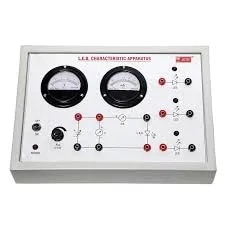
LED Characteristics Apparatus
Description
The LED Characteristics Apparatus is a laboratory instrument designed to study the voltage-current (V-I) and sometimes power-intensity (P-I) characteristics of a Light Emitting Diode (LED), illustrating its behavior under forward bias conditions.
Apparatus Description
This setup typically includes a regulated DC power supply (often 0–2.5 V), two meters to display voltage and current, and at least one LED mounted on the front panel with series resistors for current protection. The apparatus allows connection using patch cords, with one meter measuring the voltage across the LED and the other measuring current through it.
Working Principle
An LED is a p-n junction semiconductor which, when forward biased, emits visible light as electrons recombine with holes, releasing energy as photons. The V-I characteristic reveals that the current through the LED remains negligible until a threshold voltage (typically 1.8–2.2 V, depending on color) is reached. Beyond this voltage, current increases rapidly with voltage, and the LED emits light proportionally to the current.
Typical Experimental Procedure
The power supply voltage is gradually increased from zero in small steps.
For each voltage increment, the voltage across the LED and the current passing through it are recorded.
The threshold voltage (when the LED starts to glow) is noted.
A V-I graph is plotted to analyze the non-linear relationship and find the threshold voltage.
This apparatus is widely used for educational demonstrations and to characterize LED performance in laboratory experiments
Specifications
| Model No. | N-EL031 |
|---|


