
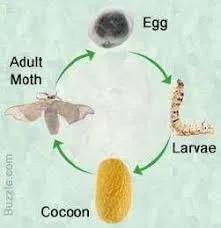
Life History Of Silk Moth
Description
The life history of the silk moth (Bombyx mori) is a classic example of complete metamorphosis and includes four major developmental stages: egg, larva (caterpillar or silkworm), pupa (inside cocoon), and adult moth.
Stages of the Silk Moth Life Cycle
Egg: The cycle starts when a female silk moth lays 300–400 small, oval eggs, usually on the underside of leaves. Eggs hatch in 7–10 days in spring or under favorable conditions.
Larva (Silkworm/Caterpillar): The emerging larvae are tiny and hairy, feeding voraciously on mulberry leaves. This larval stage lasts 3–4 weeks and includes several molts as the caterpillar grows considerably in size.
Cocoon (Pupa): When fully grown, the caterpillar spins a cocoon around itself using liquid silk secreted from special glands. The cocoon is a protective shell made of a continuous silk filament. Within the cocoon, the larva transforms into an immobile pupa over 2–3 weeks.
Adult Moth: The adult silk moth emerges from the cocoon, leaving behind the empty shell. Adults are short-lived, lacking functional mouthparts; their sole purpose is to mate and lay the next generation of eggs, restarting the cycle.
Additional Details
The total life cycle from egg to adult typically takes 6–8 weeks.
Silk is harvested by boiling the cocoon before the moth emerges to keep the thread continuous.
Silk moths and silkworms are collectively vital for sericulture, with the silk produced exclusively by the larval (caterpillar) stage.
This complete metamorphic cycle demonstrates dramatic changes in form, specializations for different life stages, and economic importance in silk production.
Specifications
| Model No. | N-EM083 |
|---|


