
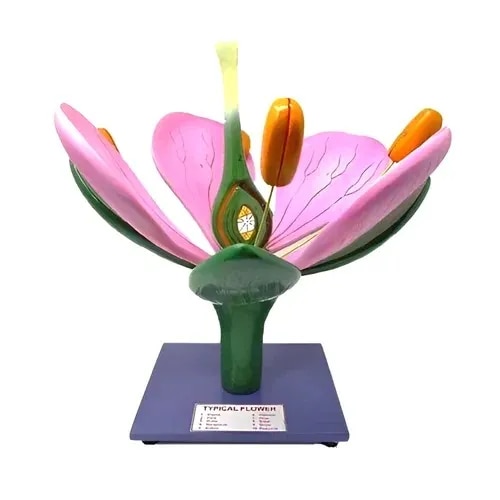
Ls Flower
Description
“L.S Flower” refers to the longitudinal section (L.S) of a flower, which is a vertical cut through the central axis of a flower to display its internal structures and arrangement of floral organs. This type of sectional diagram is commonly studied in biology to understand flower anatomy and reproductive parts.
Key Parts Observed in L.S. of a Flower
Sepals (Calyx): The outermost whorl, usually green, that protects the flower bud before it opens.
Petals (Corolla): Brightly colored structures found just inside the sepals; they attract pollinators.
Stamens (Androecium): The male reproductive parts, each consisting of a filament and anther (which produces pollen).
Carpels/Pistil (Gynoecium): The female reproductive organ, made up of stigma (receives pollen), style (connects stigma and ovary), and ovary (contains ovules which develop into seeds after fertilization).
Receptacle and Pedicel: The base and stalk of the flower, supporting the floral parts.
Significance
The L.S. of a flower clearly demonstrates the internal arrangement and relationship between reproductive and non-reproductive parts, enabling a better understanding of pollination, fertilization, and seed development. This is a foundational concept in plant morphology and is commonly included in educational diagrams and practical biology classes.
Specifications
| Model No. | N-EM0121 |
|---|


