
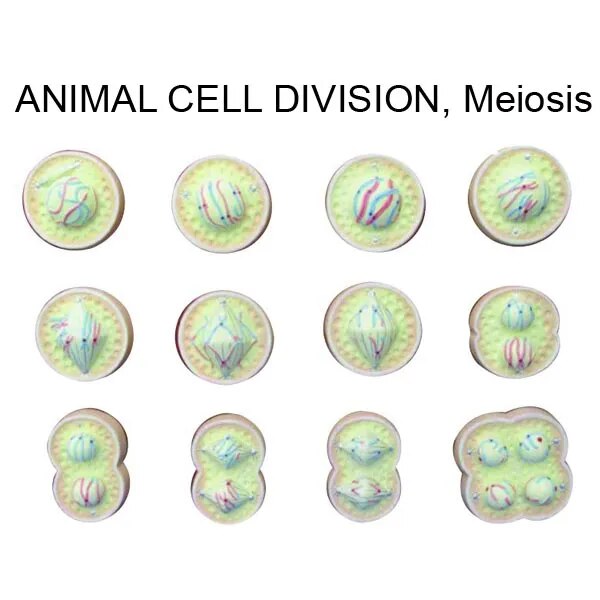
Meiosis(Animal Cell Divison) Large Size
Description
A large-size model of meiosis (animal cell division) visually demonstrates the two sequential cellular divisions that reduce chromosome number by half, resulting in four genetically unique haploid gametes. Such models are ideal for classroom teaching to clearly show each distinct phase.
Overview of Meiosis in Animal Cells
Meiosis consists of two major divisions: Meiosis I (reductional division) and Meiosis II (equational division).
Phases of Meiosis
Meiosis I:
Prophase I: Chromosomes condense, homologous chromosomes pair up and undergo crossing over for genetic variation.
Metaphase I: Homologous pairs align at the cell equator, spindle fibers attach.
Anaphase I: Homologous chromosomes are pulled to opposite poles; sister chromatids remain joined.
Telophase I and Cytokinesis: Nuclei form, cell divides into two haploid cells.
Meiosis II (resembles mitosis):
Prophase II: Chromosomes condense, new spindles form in each cell.
Metaphase II: Chromosomes align at the equator.
Anaphase II: Sister chromatids separate and move to opposite poles.
Telophase II and Cytokinesis: Four haploid cells form, each with half the original chromosome number.
Model Features
Large-size educational models display all meiotic stages with color-coded chromosomes, division spindles, and key structures (centrosomes, cell membrane).
Models clearly illustrate genetic recombination (crossing over), chromosomal alignment, separation of homologs in Meiosis I, and of sister chromatids in Meiosis II.
Some models also show differences between animal and plant meiosis by demonstrating animal cell cleavage and plant cell plate formation.
Key Concepts
Meiosis ensures genetic diversity through crossing over and random chromosome assortment during gamete formation.
Accurate chromosome reduction prepares for fertilization, restoring diploid chromosome number in offspring.
Such large-scale models help students visualize the complex, multi-step process of meiosis in animal cells, highlighting the events responsible for genetic diversity and sexual reproduction.
Specifications
| Model No. | N-EM087 |
|---|


