
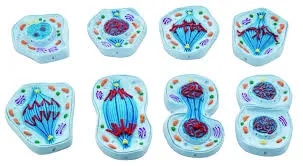
Mitosis(Cell Division) Meisos Large Size
Description
Mitosis (Cell Division) and Meiosis are two types of cell division processes in eukaryotic organisms, each with unique functions and stages. Both can be illustrated in large-size educational charts showing their stepwise stages and contrasting features.
Mitosis: Key Stages and Features
Purpose: Produces two genetically identical daughter cells for growth, tissue repair, and asexual reproduction.
Phases:
Prophase: Chromosomes condense, spindle forms, nuclear envelope dissolves.
Metaphase: Chromosomes align at the cell equator.
Anaphase: Sister chromatids separate and move to opposite poles.
Telophase: Nuclear envelope re-forms, chromosomes decondense, followed by cytokinesis.
Result: Two diploid (2n) cells, identical to the original cell.
Meiosis: Key Stages and Features
Purpose: Produces four genetically unique haploid (n) gametes (sperm/egg), essential for sexual reproduction and genetic diversity.
Phases:
Meiosis I: Homologous chromosomes pair and undergo crossing over in prophase I, align in metaphase I, and are separated in anaphase I; the cell divides at telophase I.
Meiosis II: Similar to mitosis; sister chromatids separate and are distributed to four cells during a second division.
Result: Four haploid cells, each with half the original chromosome number and unique genetic combinations due to crossing over and independent assortment.
Specifications
| Model No. | N-EM0143 |
|---|


