
Multiple Fissin
Description
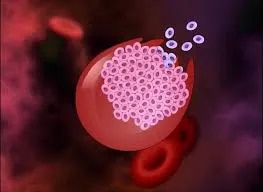
Multiple fission is a type of asexual reproduction in which a single parent cell divides to produce several (often many) daughter cells simultaneously, unlike binary fission where only two are produced.
Steps of Multiple Fission
Preparation/Cyst Formation: In many protozoans (like Amoeba or Plasmodium), the parent cell often develops a thick protective membrane called a cyst, especially under unfavorable conditions.
Nuclear Division: The nucleus of the parent cell divides repeatedly by mitosis or amitosis, producing many nuclei within the same cell.
Cytoplasmic Division: The cytoplasm then divides, and each nucleus gets surrounded by a segment of cytoplasm, eventually forming multiple daughter cells inside the parent.
Release of Daughter Cells: The cyst or parent cell wall breaks open (often when conditions become favorable), releasing all the new daughter cells into the environment at once.
Examples
Amoeba: Multiple fission in amoeba often happens inside a cyst during unfavorable conditions; many amoebae are released when the cyst ruptures.
Plasmodium (malarial parasite): Multiple fission (schizogony) results in many daughter cells (merozoites) in the liver and red blood cells, which is critical in the life cycle and symptoms of malaria.
Other Protozoans and Algae: Seen in organisms such as Paramecium (some stages), Sporozoa, and some unicellular algae.
Specifications
| Model No. | N-EM0140 |
|---|


