
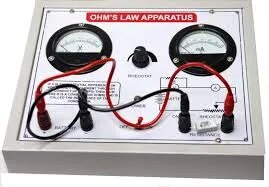
Ohm’s Law Apparatus
Description
Main Function: The apparatus allows controlled application of voltage across a known resistor and precise measurement of current through it, enabling direct observation of Ohm’s Law:
V
=
I
R
V=IR, where
V
V is voltage,
I
I is current, and
R
R is resistance.
Construction: Typically consists of a mounted resistance wire (like nichrome or manganin) connected between sturdy terminals. The setup includes a variable power supply, an ammeter to measure current, and a voltmeter to measure the potential difference across the wire.
Features:
Graduated scale for accurate voltage and current readings.
Provision for varying the length or material of resistance wire to study changes in resistance.
Safe and durable mounting for repeated classroom and laboratory use.
Operation: Users adjust the applied voltage and record corresponding current values. Plotting
V
V vs
I
I gives a straight line if Ohm’s Law is valid, with the slope providing the wire’s resistance.
This apparatus is fundamental for teaching and experimentally confirming the linear relationship between voltage and current, helping to illustrate key electrical concepts in physics and electronics education.
Specifications
| Model No. | N-EL047 |
|---|


