
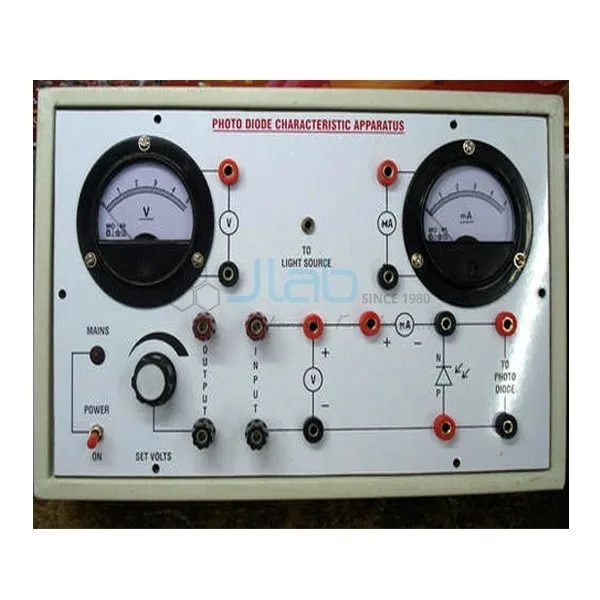
Photo Diode Characteristics Apparatus
Description
The Photo Diode Characteristics Apparatus is a laboratory device designed for studying the electrical response of a photodiode under varying light intensities and bias voltages, typically focusing on its I-V (current-voltage) characteristics.
Apparatus Description
This setup generally includes a regulated DC power supply (0–10 V), two analog or digital meters (voltmeter and ammeter), a photodiode enclosed in a dark box, and a controllable light source such as an LED or bulb. The photodiode is mounted so that its light-sensitive surface receives adjustable illumination from the source, and the ambient light is minimized using an enclosure.
Working Principle
A photodiode is a semiconductor device that converts incident photons into electrical current. When reverse biased, the device shows a small leakage current (dark current), which increases proportionally to incident light intensity due to the generation of electron-hole pairs in the depletion region. The apparatus enables measurement of current through the photodiode as a function of applied voltage and incident light level, revealing photosensitivity and threshold behaviors.
Typical Experimental Procedure
The light source is adjusted to vary intensity incident on the photodiode.
For each light setting, the voltage across and the current through the photodiode (in reverse bias) are measured.
Observed values are recorded to plot I-V characteristics, demonstrating that current increases with both incident light and applied bias.
This apparatus is used in educational laboratories to help students visualize the principles of optoelectronics and the distinctive behavior of photodiodes under different illumination and biasing conditions.
Specifications
| Model No. | N-EL032 |
|---|


