
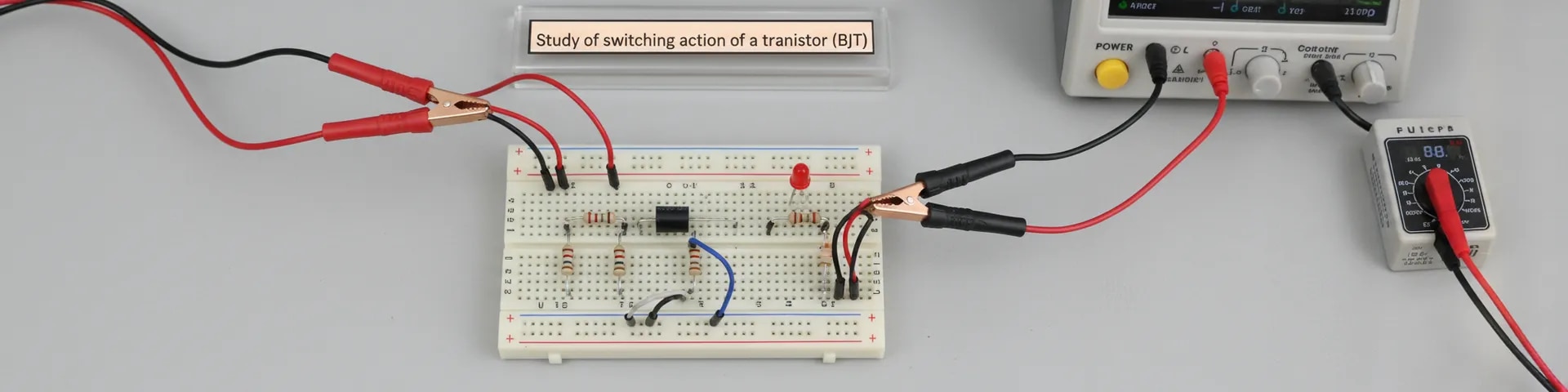
Study of switching action of a transistor (BJT)
Description
The BJT switch operates in two key regions:
Cut-off region: Both the base-emitter and base-collector junctions are reverse biased, resulting in no collector current. The transistor is OFF, and the load circuit is open.
Saturation region: Both junctions are forward biased, the transistor is fully ON, and maximum current flows from collector to emitter, effectively closing the switch.
An experiment typically includes a BJT connected with base biasing resistors, a load (such as an LED), a power supply, and input base control signals.
The input signal controls base current; when high enough, it saturates the BJT and energizes the load. When the base input is removed or low, the transistor switches off.
Measurements of base current (
I
B
I
B
), collector current (
I
C
I
C
), and collector-emitter voltage (
V
C
E
V
CE
) verify the transistor's switching behavior.
Visual indicators (LEDs) are often used to clearly show the switch state, and waveforms can be observed with oscilloscopes if needed.
This study is crucial for understanding transistor operation in digital logic, switching power supplies, and other electronic control applications, illustrating fundamental transistor physics and practical circuit design.
Specifications
| Model No. | N-EL072 |
|---|


