
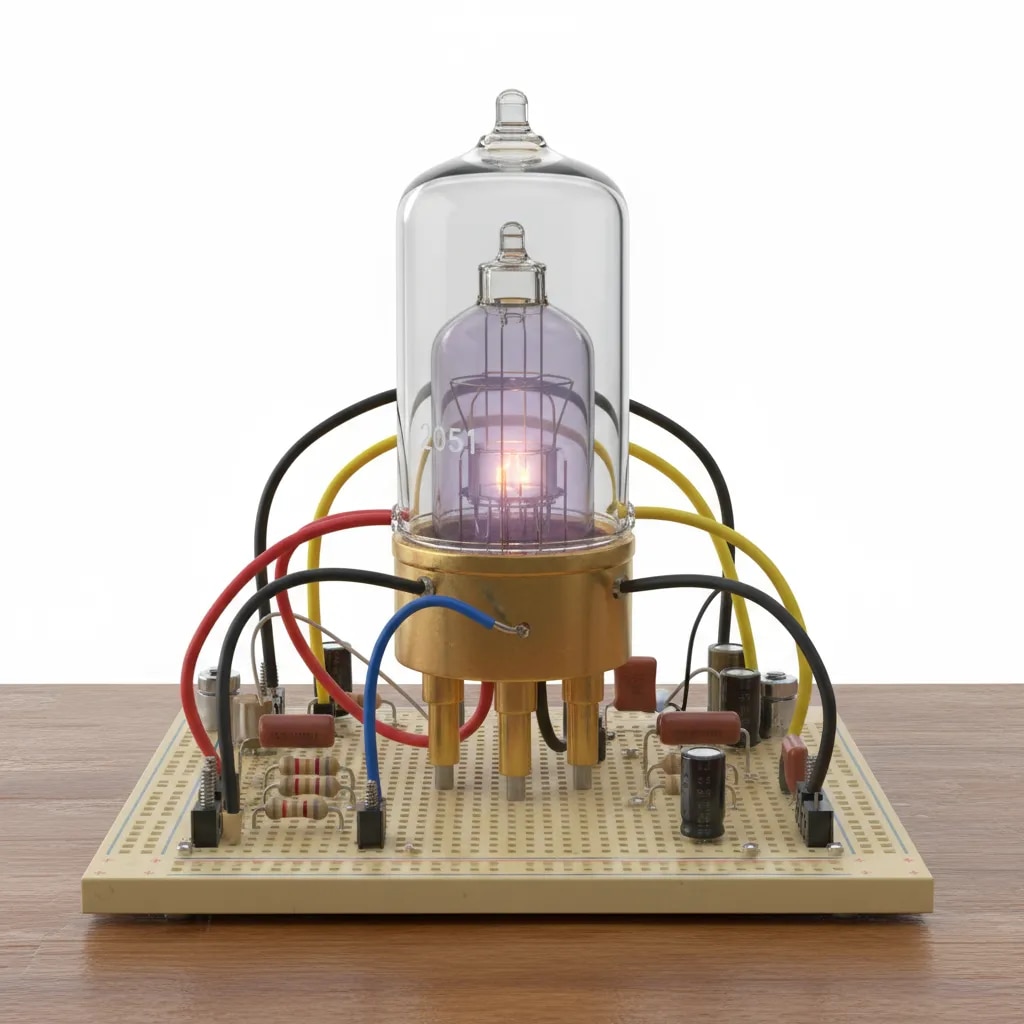
Thyratron Valve (2051) on Board.
Description
The Thyratron Valve (2051) on Board is a gas-filled tube designed for high-power electrical switching and controlled rectification. It operates by ionizing the gas inside the tube to form a plasma that conducts electricity between the anode and cathode when triggered by the control grid.
Key Features
Gas-filled Tube: Contains an inert gas such as hydrogen or mercury vapor at low pressure, housed in a glass envelope.
Heater Voltage: Typically 6.3V heating the cathode to emit electrons for ionization.
Operating Principle: Remains non-conductive until the grid voltage triggers ionization, after which it conducts current until the anode current drops below a threshold.
Switching Capability: Capable of handling high voltages and currents with fast switching times, useful in pulse power applications.
Control Grid: Regulates conduction initiation by controlling electron flow and gas ionization, enabling precise switching control.
Applications: Employed in radar pulse generation, high-voltage power supplies, ionization measurement setups, and industrial power control.
Operational Context
Known for replacing mechanical switches and relays in high-power, high-speed switching contexts.
Requires a recovery period to cease conduction and reset ionization state, limiting switching frequency to a few kHz.
Variation of thyratrons including double grid and specialized types exist for different switching and amplification needs.
This 2051 thyratron valve on board is a vital component in high-power switching and controlled rectification circuits, combining robust electrical characteristics with reliable gas ionization technology for demanding electronic applications.
Specifications
| Model No. | N-EC008 |
|---|


