
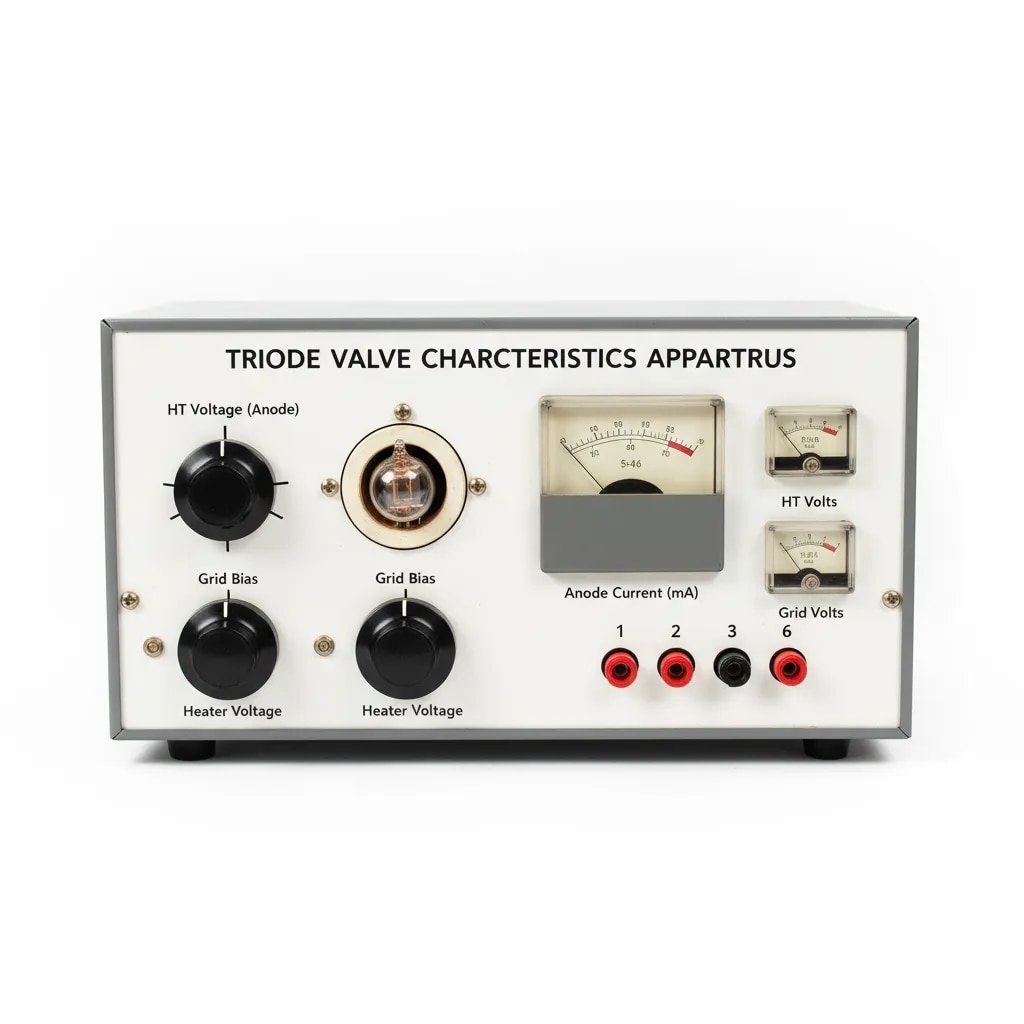
Triode Valve Characteristics Apparatus
Description
A Triode Valve Characteristics Apparatus is a specialized laboratory instrument designed to investigate the electrical properties and behavior of triode vacuum tubes (triode valves). It typically includes mounting sockets for triode tubes, regulated DC power supplies for anode voltage (0-300 VDC) and filament voltage (6.3V AC), and analog meters for measuring plate voltage and current.
Components and Function
Triode Vacuum Tube Socket: Holds the triode valve in place for electrical testing.
DC Regulated Power Supply: Provides adjustable high voltage to the anode to vary tube operation.
AC Power Supply: Supplies filament or heater voltage to the cathode for thermionic emission.
Measurement Instruments: Voltmeters and ammeters allow observation of voltage and current to plot characteristic curves.
Control Knobs and Switches: Enable fine control of voltages and testing modes for experimentation.
Purpose and Usage
Shows the current-voltage (I-V) characteristics of triode valves under different bias voltages and anode voltages.
Demonstrates amplification, control grid function, cut-in voltages, and plate current modulation.
Used extensively in electronics education and research laboratories to better understand triode operation.
Facilitates hands-on learning about the role of each electrode and tube parameters like transconductance and amplification factor.
This apparatus provides critical insights into triode valve physics and operation, supporting the teaching and practical application of vacuum tube electronics.
Specifications
| Model No. | N-EL002 |
|---|


