
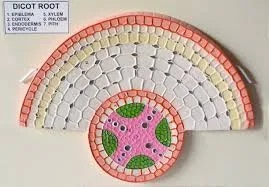
T.S. Dicot Root
Description
A T.S. (transverse section) of a monocot stem reveals its unique internal anatomy, which is distinct from dicot stems. Monocot stems are typically exemplified by plants like maize, bamboo, and grasses.
Key Anatomical Features
Epidermis: The single outermost protective cell layer, usually covered by a cuticle to prevent water loss. Stomata and multicellular hairs are typically absent or fewer in number.
Hypodermis: Lies just below the epidermis, made of sclerenchyma cells which provide mechanical strength.
Ground Tissue: The majority of the stem is occupied by undifferentiated parenchyma cells called ground tissue, with no clear demarcation into cortex, endodermis, pericycle, or pith.
Vascular Bundles: Numerous (many), scattered throughout the ground tissue (not arranged in a ring). Each vascular bundle is surrounded by a sclerenchymatous bundle sheath and is “closed” (lacking cambium, so no secondary growth).
Xylem: Generally 'Y' or 'V' shaped arrangement, with metaxylem and protoxylem. A cavity may be present at the base due to lysed protoxylem (protoxylem lacuna).
Phloem: Located outside the xylem. Consists of sieve tubes and companion cells; phloem parenchyma and fibers are absent.
Pith: Generally absent or indistinct in monocot stems, as most of the central tissue is similar parenchyma.
Specifications
| Model No. | N-EM0127 |
|---|


