
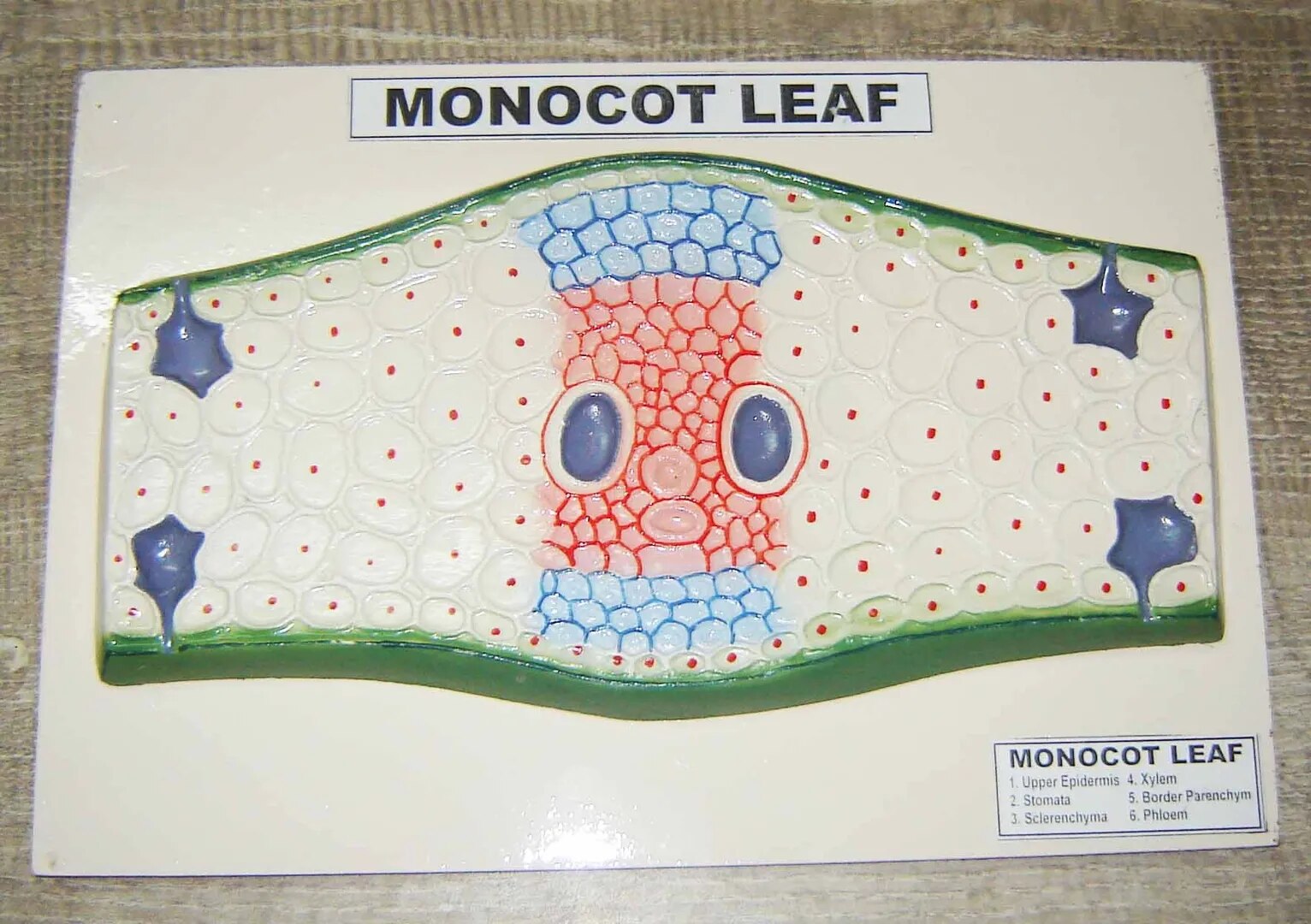
T.S . Monocot Leaf
Description
A T.S. (transverse section) of a monocot leaf—such as those of grasses or maize—shows unique anatomical features that distinguish it from a dicot leaf. Monocot leaves are also known as “isobilateral” because their internal anatomy is largely similar on both sides.
Key Anatomical Features
Upper and Lower Epidermis: Both surfaces are covered by a single layer of closely packed parenchymatous cells with a cuticle for protection. Stomata are present on both epidermal layers, and some cells in the upper epidermis—called bulliform (motor) cells—are large and thin-walled, enabling leaf rolling during water stress to reduce water loss.
Mesophyll: The entire ground tissue between the epidermal layers is called mesophyll, which is not differentiated into palisade and spongy parenchyma (unlike dicots). Mesophyll cells are isodiametric with intercellular spaces and contain numerous chloroplasts for photosynthesis.
Vascular Bundles: Many vascular bundles of varying sizes run parallel within the leaf. Each vascular bundle contains xylem (towards the upper epidermis) and phloem (towards the lower epidermis); all are surrounded by a parenchymatous bundle sheath. Larger vascular bundles may have extra layers or sclerenchyma for support.
Specialized Cells: Bulliform cells (aid in leaf curling), silica cells (for rigidity), and subsidiary cells (associated with guard cells of stomata) are often present.
Specifications
| Model No. | N-EM0125 |
|---|


