
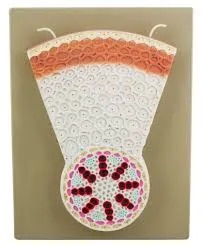
T.S . Monocot Root
Description
A T.S. (transverse section) of a monocot root, such as maize or wheat, exhibits distinct internal features that set it apart from dicot roots. Monocot roots are typically involved in fibrous root systems and show adaptations for absorption and anchorage.
Key Anatomical Features
Epidermis (Epiblema): The outermost uniseriate layer, often thin-walled, without cuticle. Root hairs arise from here, aiding in water and nutrient absorption.
Cortex: This broad parenchymatous region stores food and transports absorbed water/minerals inward. It lacks chloroplasts and is often many cells thick.
Endodermis: The innermost cortex layer, characterized by the presence of Casparian strips (suberized or thickened radial and tangential walls), which control solute passage into the vascular cylinder.
Pericycle: A thin layer of parenchyma just inside the endodermis, giving rise to lateral roots. It does not contribute to secondary growth in monocots.
Vascular Bundles (Stele):
Radial arrangement: Xylem and phloem are organized in alternate radii (not together in bundles).
Polyarch: Numerous (8 or more) xylem and phloem bundles, as opposed to 2–6 in dicots.
No cambium: Monocot roots do not have vascular cambium, so they lack secondary growth.
Pith: Large and well-developed, mainly parenchymatous, which helps distinguish monocot roots from dicot roots (where pith is usually small or absent)
Specifications
| Model No. | N-EM0126 |
|---|


