
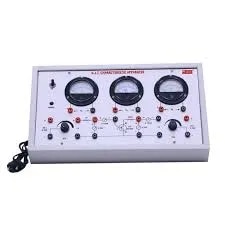
UJTCharacteristics Apparatus with Regulated Power Supplies.
Description
The UJT Characteristics Apparatus with Regulated Power Supplies is a laboratory instrument used to study the characteristics and behavior of the Unijunction Transistor (UJT). It typically features:
Two regulated DC power supplies, commonly providing voltages such as 0-15V/1.5mA and 0-25V/60mA for biasing different parts of the UJT circuitry.
A UJT device like the 2N2646 mounted on the front panel for testing.
Terminals for connecting meters and other instruments to measure emitter voltage, base voltages, and emitter current.
An instruction manual with experimental procedures for plotting UJT characteristics.
The UJT is a three-terminal device with two base terminals (B1 and B2) and one emitter terminal (E). It consists of an n-type silicon bar with a p-type emitter junction. The main characteristic is its negative resistance region, where an increase in emitter current causes a decrease in emitter voltage, useful in oscillator circuits and triggering applications.
In operation, the emitter voltage increases to a peak point, beyond which the device enters a negative resistance region until a valley point is reached, after which it saturates like a diode. The apparatus allows visualization of these regions through voltage-current plots, helping in practical understanding of UJT behavior in electronics.
Specifications
| Model No. | N-EL022 |
|---|


