
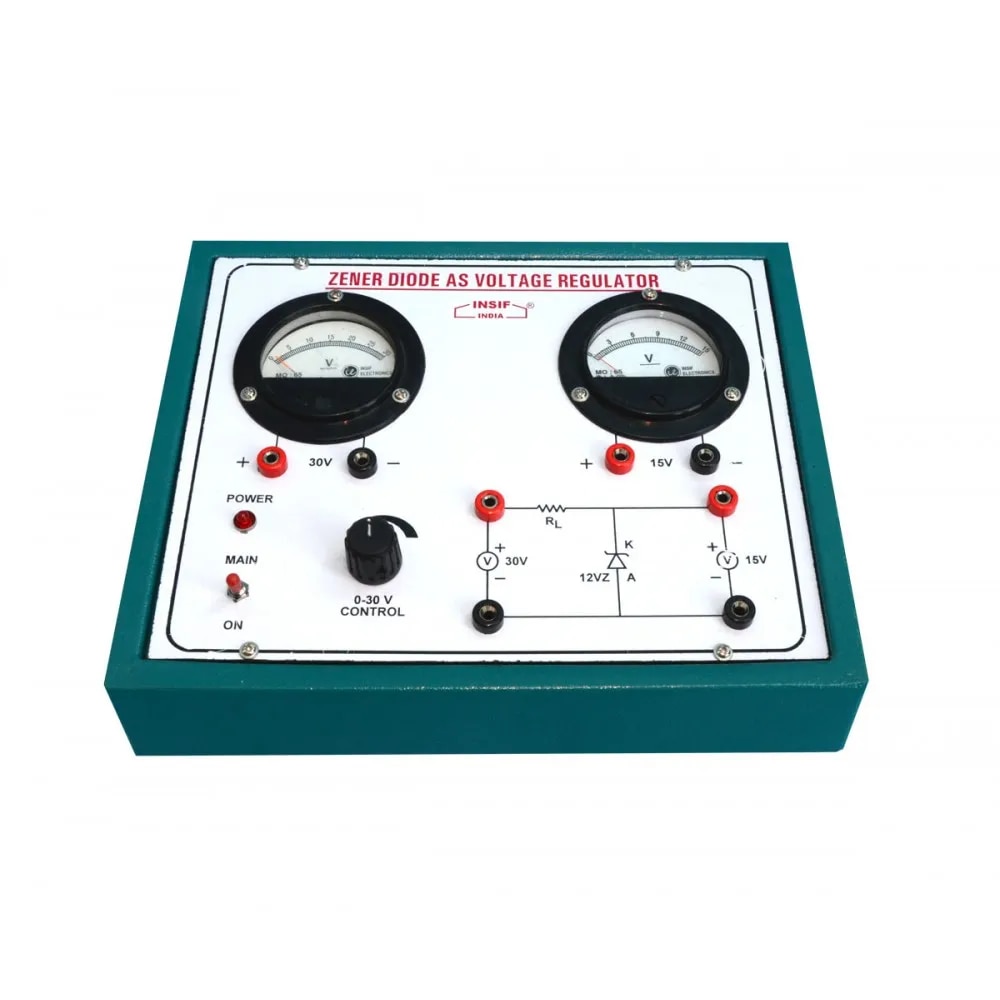
Voltage Stabilization Characteristics of Zener Diode
Description
The voltage stabilization characteristics of a Zener diode refer to its ability to maintain a nearly constant output voltage across a load even when the input voltage or load current varies, making it highly effective as a voltage regulator in electronic circuits.
Principle of Voltage Stabilization
A Zener diode is specially designed to operate in the reverse bias (breakdown) region. When the reverse voltage applied across the Zener diode exceeds its breakdown voltage (Zener voltage), the diode allows significant current to flow but keeps the voltage across itself almost constant, regardless of fluctuations in the supply voltage or load.
Experimental Setup and Description
The typical setup includes:
A DC power supply to provide varying input voltage.
A Zener diode connected in reverse bias across the load.
A series resistor to limit excess current and protect the diode.
Meters to measure input voltage, load voltage, and current.
As the input voltage is increased, the voltage across the Zener diode remains steady after the breakdown voltage is reached, demonstrating its voltage regulation property. The diode absorbs fluctuations by changing its current, but the voltage across the load remains at the Zener voltage, providing output stabilization.
Application and Importance
Zener diodes are widely used for voltage regulation in low-power circuits, providing reliable voltage references, surge suppression, and circuit protection. They are essential in maintaining stable operation of sensitive electronic devices and power supply units.
This stabilization property makes Zener diodes integral to voltage regulator designs and ensures circuit protection against input voltage surges or load variations.
Specifications
| Model No. | N-EL034 |
|---|


