Thank you for writing to us. One of our executive will reach back to you through your submitted medium. In case there’s an urgency, feel free to connect over WhatsApp for faster response.
Prefer calling? Dial +918048036175 (International callers) or 08048036175 (Indian callers).
Chromium bromide refers to chromium(III) bromide (CrBr₃), an inorganic compound appearing as dark green or black hexagonal crystals. It has a molecular weight of 291.71 g/mol, density of 4.68 g/cm³, and melting point of 1130°C, with low solubility in cold water but solubility in hot water.
The structure features chromium in the +3 oxidation state in a layered hexagonal lattice, exhibiting ferromagnetic properties at low temperatures, making it suitable as a 2D semiconductor for spintronics and optical applications.
Used as a catalyst for olefin polymerization and in materials research, it requires careful handling due to its corrosiveness and toxicity as a chromium compound.
Chromium borate refers to chromium(III) borate with the formula CrBO₃ or related forms like BCrO₃. It appears as a crystalline solid with a calcite-type trigonal structure, where boron forms sp² hybridized BO₃ trigonal planar units linked to octahedral Cr³⁺ centers.
The compound has a molecular weight of approximately 110.81 g/mol and exhibits properties studied for optical applications, including thin films with specific vibrational modes in IR spectroscopy around 530 cm⁻¹ (Cr-O) and 1150 cm⁻¹ (B-O). It is prepared via methods like solid-state reactions and shows potential in luminescent materials and antiferromagnetic behavior.
Used in ceramics, optical coatings, and as a precursor in borate glass systems doped with chromium oxide, it requires handling precautions due to chromium toxicity.
Chromium acetate generally refers to a family of compounds containing chromium and acetate ligands, with the common form being chromium(III) acetate, also known as basic chromium acetate. Its characteristic cation is [Cr3O(O2CCH3)6(H2O)3]+, featuring three chromium(III) centers bridged by a triply bridging oxo ligand, six acetate ligands, and three aquo ligands. It appears as a blue or grey-green powder soluble in water.
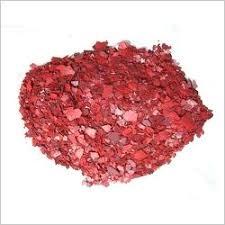
Chromium(II) acetate hydrate, another related compound, has the formula Cr2(CH3CO2)4(H2O)2. It is a red-colored compound with a notable quadruple bond between chromium atoms, and exists in dihydrate and anhydrous forms. This molecule has an octahedral geometry around each chromium and is diamagnetic due to the metal-metal bonding.
Chromium acetates decompose on heating, ultimately forming chromium oxide, and are used in industrial applications such as catalysts and pigments. They are somewhat soluble in water and typical inorganic solvents.
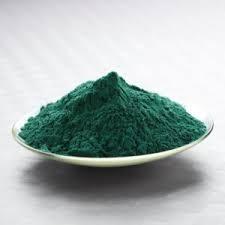
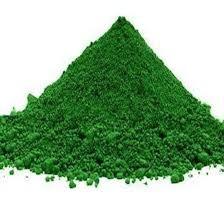
Chromium(III) oxide green, with the formula Cr2O3, is an inorganic compound known as chromia or chrome green. It appears as a fine green powder or crystals with a hexagonal corundum crystal structure. The oxide consists of a hexagonal close-packed array of oxide ions with two-thirds of the octahedral holes occupied by chromium(III) ions. It is very hard (Mohs hardness 8-8.5) and brittle, with a melting point of 2435°C and boiling point above 3000°C. It is practically insoluble in water, alcohol, and acetone and slightly soluble in acids and alkalis.
Chemically, it is amphoteric, dissolving in acids to give chromium(III) ions and in concentrated alkalis to form chromite ions. It is antiferromagnetic up to about 307 K and exhibits excellent chemical stability and resistance to heat, acids, and alkalis, making it widely used as a stable green pigment ('chrome green') in paints, ceramics, glass, and inks. It is also employed in refractory materials and as an electrode material in lithium-ion batteries.
The compound has a density of approximately 5.22 g/cm³, is odorless, and its green color is highly stable, resistant to fading by light or heat. Natural chromium(III) oxide occurs as the mineral eskolaite
Chromic acid extra pure refers to a high-purity form of chromic acid, a strong oxidizing agent with the chemical formula H2CrO4. It typically exists as an aqueous solution derived from chromium trioxide (CrO3) dissolved in water. The structure involves a chromium atom at the center bonded to four oxygen atoms; two oxygens are double-bonded to chromium, and the other two are single-bonded and each bonded to a hydrogen atom, giving the molecule a tetrahedral arrangement. It is a dark red or purplish-red solution, odorless with a melting point around 197°C and boiling point about 250°C.
Chromic acid is highly corrosive, toxic, and an environmental hazard due to hexavalent chromium. It is widely used in laboratories and industries for strong oxidation reactions, such as oxidizing alcohols into ketones or carboxylic acids, chrome plating, cleaning glassware, and organic synthesis. Its strong oxidizing nature arises from chromium in the +6 oxidation state, which readily accepts electrons to reduce to more stable states
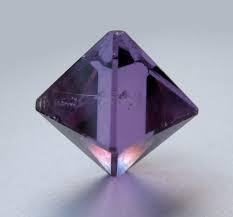
Chrome alum, or chromium(III) potassium sulfate, has the chemical formula KCr(SO₄)₂, most commonly as the dodecahydrate KCr(SO₄)₂·12H₂O. It appears as dark purple needles, violet crystals, or greyish-brown powder (anhydrous), with a molar mass of 499.4 g/mol (dodecahydrate), density of 1.83 g/cm³, and melting point around 89-90°C (decomposes). The compound forms regular octahedral crystals, is highly soluble in water (forming acidic, astringent solutions that redden litmus), and solutions shift from violet to green above 50°C due to complex formation.
It is produced by reducing potassium dichromate with SO₂ in sulfuric acid or from ferrochromium alloys. Chrome alum exhibits efflorescence, losing water in air, and is isomorphous with other alums like potash alum.
Widely used in leather tanning (chrome tanning), textile mordanting, photography fixing baths, and analytical chemistry. It is irritant and toxic, requiring protective handling.
Cholesterol is a sterol lipid with the molecular formula C₂₇H₄₆O and molar mass of 386.65 g/mol, appearing as a white, waxy, crystalline powder. It features a tetracyclic steroid nucleus (cyclopentanoperhydrophenanthrene ring system) with a double bond between carbons 5 and 6, a hydroxyl group at the 3β position, and an eight-carbon hydrocarbon side chain at carbon 17. The compound has a melting point of 148-150°C, density of 1.052 g/cm³, and is practically insoluble in water but soluble in organic solvents like chloroform and ethanol.
Structurally amphipathic, cholesterol's polar hydroxyl group orients toward the aqueous environment while its nonpolar rings and tail embed in lipid bilayers, modulating membrane fluidity, packing, and permeability in animal cells. It serves as a precursor for bile acids, vitamin D, and steroid hormones (e.g., cortisol, estrogen, testosterone) via the mevalonate pathway, starting from acetyl-CoA.
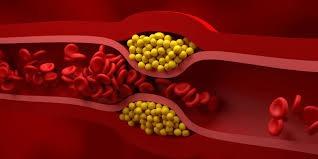
Endogenously synthesized mainly in the liver, it is also dietary from animal products; excess levels contribute to atherosclerosis, managed by statins targeting HMG-CoA reductase.
Cholesterol is a sterol lipid with the molecular formula C₂₇H₄₆O and molar mass of 386.65 g/mol, appearing as a white, waxy, crystalline powder. It features a tetracyclic steroid nucleus (cyclopentanoperhydrophenanthrene ring system) with a double bond between carbons 5 and 6, a hydroxyl group at the 3β position, and an eight-carbon hydrocarbon side chain at carbon 17. The compound has a melting point of 148-150°C, density of 1.052 g/cm³, and is practically insoluble in water but soluble in organic solvents like chloroform and ethanol.
Structurally amphipathic, cholesterol's polar hydroxyl group orients toward the aqueous environment while its nonpolar rings and tail embed in lipid bilayers, modulating membrane fluidity, packing, and permeability in animal cells. It serves as a precursor for bile acids, vitamin D, and steroid hormones (e.g., cortisol, estrogen, testosterone) via the mevalonate pathway, starting from acetyl-CoA.
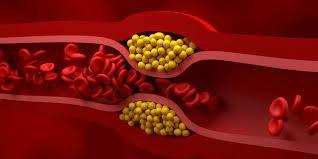
Endogenously synthesized mainly in the liver, it is also dietary from animal products; excess levels contribute to atherosclerosis, managed by statins targeting HMG-CoA reductase.
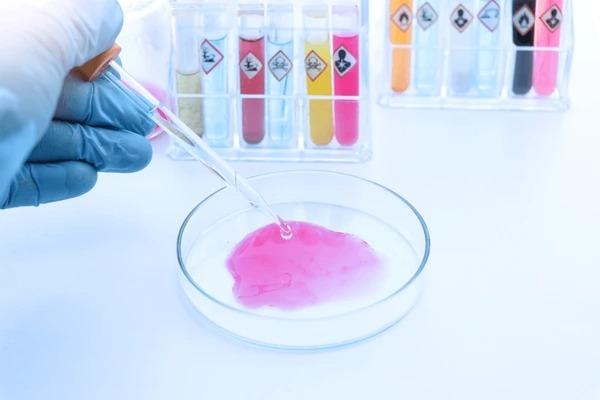
Chlorophenol red pH indicator solution is an aqueous or alcoholic preparation of chlorophenol red (C₁₉H₁₂Cl₂O₅S), a sulfonphthalein dye used for pH detection in the range of 4.8-6.7, changing from yellow (acidic) to violet or red-purple (basic).
The solid dye appears as a dark brown to reddish-brown powder with λ_max at 572 nm, pKa around 6.0, melting point of 261°C, and sparing solubility in water but good solubility in ethanol (e.g., 10 mg/mL in 95% ethanol). In solution, it dissociates via loss of a proton from the phenolic OH, shifting the chromophore structure and color due to resonance stabilization.
Typically prepared as 0.04-0.1% (w/v) in 50% ethanol or water-ethanol mixes for lab use in titrations, chlorine dioxide detection (0.1-1.9 mg/L at pH 7), enzyme assays, and microbial studies; handle as irritant with eye/skin protection.
Chloroform extra pure is a high-purity grade of trichloromethane (CHCl₃), a colorless, volatile liquid with a sweet, ethereal odor and tetrahedral molecular geometry where a central carbon atom bonds to one hydrogen and three chlorine atoms.
It has a molecular weight of 119.38 g/mol, density of 1.49 g/cm³, melting point of -63.5°C, and boiling point of 61.2°C, with low water solubility (~0.8 g/100 mL) but miscibility in ethanol, ether, and benzene. Extra pure grades minimize impurities like ethanol (stabilizer) and heavy metals for analytical, solvent, and extraction uses in labs.
Chemically nonflammable and stable but forms phosgene (toxic gas) on air/light exposure or oxidation; reacts with hot NaOH to yield formate. Highly toxic (carcinogen, CNS depressant, liver/kidney damage), handle in fume hood with gloves/respirator.
Concentrated chlorine water is an aqueous solution saturated with chlorine gas (Cl2), typically having a chlorine concentration around 0.5% to 1.5% by weight, giving it a pale yellow-green color and a strong chlorine odor. It is a potent oxidizing and disinfecting agent.
Chemical composition involves dissolved Cl2 reacting with water to form a dynamic equilibrium mixture of chlorine (Cl2), hydrochloric acid (HCl), and hypochlorous acid (HOCl), described by:
Cl2 + H2O ⇌ HCl + HOCl
This mixture accounts for chlorine water's strong bleaching, disinfecting, and oxidizing properties. Concentrated chlorine water is corrosive, volatile, and may release toxic chlorine gas, requiring storage in cool, dark containers with ventilation and proper handling to avoid exposure hazards. It is widely used for sterilization, water treatment, and in chemical synthesis as a chlorinating or oxidizing agent. Concentrated chlorine water is hazardous and must be handled with appropriate personal protective equipment (PPE) in well-ventilated areas.
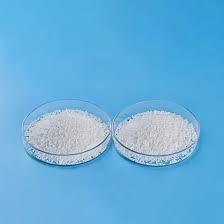
Charcoal animal granular (animal charcoal in granular form) is a porous, black, grainy adsorbent material produced by charring animal bones or other animal tissue and then crushing/sizing it into small granules rather than powder.
Composition and form
The granules consist mainly of carbon with significant calcium phosphate and calcium carbonate content originating from bone, giving them a hard, durable structure and a high internal surface area.
Being granular (typically a few millimetres in size) makes the material free‑flowing, easy to handle in filters or feed mixes, and less dusty than powdered grades.
Main uses
Animal granular charcoal (bone char) is widely used as an adsorbent for decolorising and purifying liquids such as sugar solutions and other process streams, and as a filtration medium in water treatment.
Granular charcoal of animal or vegetal origin is also formulated as an animal feed supplement, where it is added in small amounts to help bind intestinal toxins and gases, support digestion, and reduce odours in species such as horses, cattle, dogs, cats, and poultry.